

Plastic and Glass Packer Bottle Compatibility Guide
Posted by Discount Vials - A BASCO Company on Apr 17, 2026
When selecting the right packer bottle for your product, one of the most common questions is: How many capsules or tablets will fit?
Whether you're packaging supplements, pharmaceuticals, nutraceuticals, or vitamins, choosing the correct plastic or glass packer bottle size is critical for product protection, accurate labeling, and customer satisfaction.
This guide breaks down packer bottle compatibility, capacity considerations, and how to match capsule sizes with the right container.
Plastic vs. Glass Packer Bottles
Plastic and glass packer bottles serve the same purpose but perform differently depending on the product being stored. Plastic packer bottles, typically made from PET or HDPE, are lightweight, durable, and cost-effective for shipping and large-scale production. They are widely used in the supplement and nutraceutical industries because they reduce freight costs and hold up well during handling and transportation.
Glass packer bottles, on the other hand, are often chosen for their premium appearance and chemical stability. Amber glass provides UV protection, which is important for light-sensitive products, while clear glass allows full product visibility. Glass is also non-reactive, making it a preferred option for certain pharmaceutical and high-end supplement applications. While heavier than plastic, glass packer bottles elevate product presentation and perceived value.
Packer Bottle Capacity Measurements
Packer bottles are sized in cc (cubic centimeters), which measures the true internal volume of the container. One cc equals one milliliter (mL), providing a consistent and standardized way to compare bottle sizes across industries.
This matters because packer bottles are often filled with capsules or tablets, and the exact count can vary based on size, density, and inserts. Using cc focuses on the available space inside the bottle, giving you a more reliable starting point when selecting the right packaging.
Understanding Capsule Size
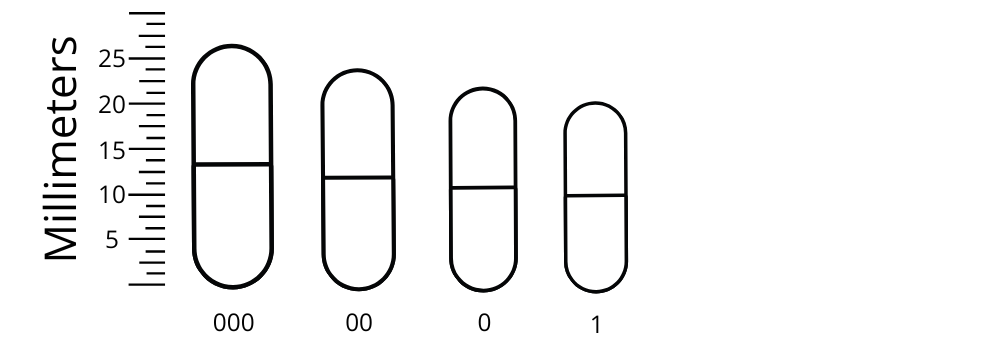
Capsule sizes are standardized and labeled as 000, 00, 0, 1, and so on. The more zeros, the larger the capsule, so size 000 is the largest, while size 1 is smaller. Each size represents a different volume, which affects how much product it can hold.
Capsule size also impacts how many will fit in a bottle. Larger capsules take up more space, resulting in lower counts per container, while smaller capsules allow for higher counts. Keep in mind that all capacity estimates can vary based on fill density, settling, and inserts like cotton or desiccants. It’s always best to test with your actual product.
Refer to the chart below for a visual comparison of capsule sizes from 000 to 1.
Packer Bottle Capacity Chart
The following chart provides general guidance for how many capsules fit into common packer bottle sizes. These values are based on typical fill conditions and should be used as a starting point for packaging selection.
| Capsule Size | Maximum Quantity of Pills | Bottle Size |
|---|---|---|
| 1 | 30 | 2 oz / 60 ml / 60 cc |
| 1 | 60 | 3.4 oz / 100 ml / 100 cc |
| 1 | 90 | 4 oz / 120 ml / 120 cc |
| 1 | 120 | 5 oz / 150 ml / 150 cc |
| 0 | 30 | 3.4 oz / 100 ml / 100 cc |
| 0 | 60 | 4 oz / 120 ml / 120 cc |
| 0 | 90 | 6 oz / 180 ml / 180 cc |
| 0 | 120 | 6.7 oz / 200 ml / 200 cc |
| 0 | 180 | 10 oz / 300 ml / 300 cc |
| 00 | 30 | 3.4 oz / 100 ml / 100 cc |
| 00 | 60 | 6 oz / 180 ml / 180 cc |
| 00 | 90 | 10 oz / 300 ml / 300 cc |
| 00 | 120 | 13.5 oz / 400 ml / 400 cc |
| 00 | 180 | 17 oz / 500 ml / 500 cc |
| 000 | 30 | 4 oz / 120 ml / 120 cc |
| 000 | 60 | 6.7 oz / 200 ml / 200 cc |
| 000 | 90 | 10 oz / 300 ml / 300 cc |
| 000 | 120 | 13.5 oz / 400 ml / 400 cc |
| 000 | 180 | 17 oz / 500 ml / 500 cc |
Key Factors That Impact Bottle Selection
While the capacity chart is helpful, choosing the right packer bottle involves more than matching capsule count to bottle size. Headspace plays a critical role in packaging performance. Leaving a small amount of space at the top of the bottle helps prevent product damage, allows room for desiccants or cotton, and improves filling efficiency during production.
Product density is another important factor. Capsules filled with different materials may settle differently, which can slightly change how many units fit into the same bottle. In addition, closure selection must be considered. Many applications require child-resistant caps, tamper-evident bands, or induction seal liners, all of which may influence how much usable space is available inside the container.
Labeling requirements should also be taken into account. Larger bottles provide more surface area for branding, regulatory information, and instructions, which can be especially important in supplement and pharmaceutical packaging.
Applications for Plastic and Glass Packer Bottles
Packer bottles are used across a wide range of industries due to their versatility and ease of use. They are commonly found in dietary supplements, vitamins, pharmaceuticals, herbal products, and CBD packaging. Plastic packer bottles are typically preferred for high-volume production and distribution, while glass packer bottles are often selected for premium retail products or formulations that require added protection.
Choosing the right plastic or glass packer bottle comes down to balancing capacity, compatibility, and product requirements. While charts and general guidelines provide a strong starting point, real-world testing is the best way to ensure your packaging performs as expected. By understanding how capsule size, bottle size, and material interact, you can make more informed decisions that support both operational efficiency and product quality.